


Sticker Printing Cost Guide: What Affects Pricing?

Sticker printing prices can vary significantly even when two orders appear similar at first glance. A simple paper label printed in a large quantity may have a very different cost structure from a waterproof vinyl sticker with custom die cutting and lamination.
This is because sticker printing cost is rarely determined by size alone.
Materials, printing quantity, production method, finishing, artwork preparation, cutting requirements and delivery can all influence the final quotation. Minimum order quantities (MOQ) and production setup can also affect the unit price, particularly for smaller orders.
For businesses in Singapore, understanding these pricing factors is useful when budgeting for custom sticker printing. It can also help prevent a common mistake: choosing the cheapest specification without considering whether the sticker will actually perform in its intended application.
A lower-cost paper sticker may be perfectly suitable for dry indoor packaging. However, if the same sticker is placed on a refrigerated bottle and deteriorates under condensation, replacing damaged labels may ultimately cost more than selecting an appropriate synthetic material from the beginning.
The objective should therefore be to find the most cost-effective specification that meets the actual application requirements—not simply the lowest initial price.
Cost Factors
Several components usually contribute to the overall cost of sticker printing.
These include:
- Sticker dimensions
- Shape
- Material
- Quantity
- Number of designs
- Printing method
- Colour requirements
- Lamination
- Die cutting
- Other finishing options
- Artwork preparation
- Packaging
- Delivery requirements
These factors are interconnected.
For example, changing from a standard rectangular paper label to a custom-shaped waterproof synthetic sticker may affect the material, cutting process, and finishing simultaneously.
Sticker Size
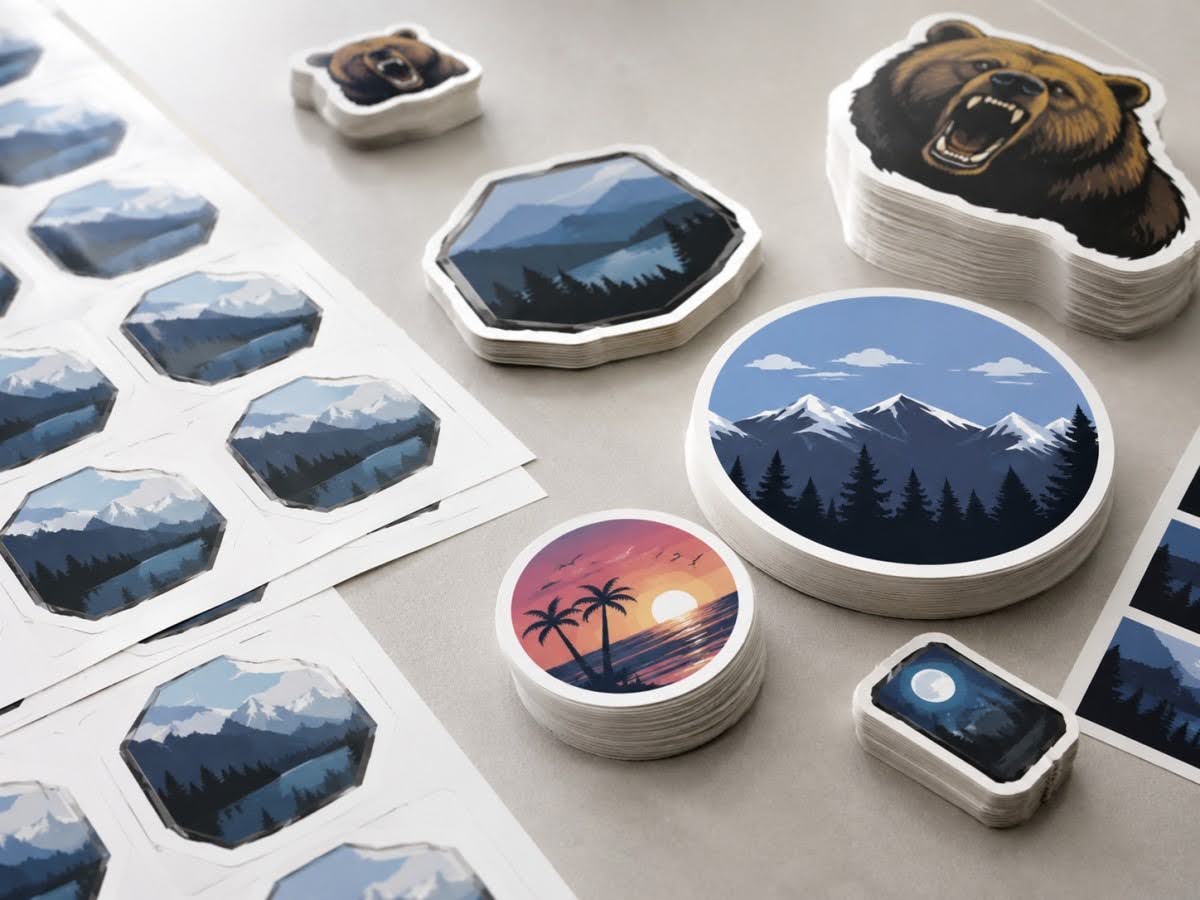
Sticker dimensions affect the amount of material required and how efficiently stickers can be arranged during production.
Larger stickers generally consume more material, but size should not be considered independently.
The layout efficiency of a print sheet or roll can also affect production economics.
A slightly smaller sticker does not necessarily produce an equivalent percentage reduction in price.
Shape and Cutting Requirements
Standard shapes such as:
- Rectangles
- Squares
- Circles
- Ovals
can be straightforward to produce.
Custom shapes may require die cutting or digital contour cutting depending on the production method.
Complex outlines can also affect production.
A simple circular logo and an intricate illustration with many narrow points may have similar dimensions but different cutting requirements.
Number of Designs
An order containing one repeated design can have different production requirements from an order containing many artwork variations.
Businesses should therefore specify whether they need:
- One design
- Multiple product variants
- Sequential information
- Different sizes
- Different shapes
This allows the printing company to determine the most efficient production setup.
Artwork Requirements
Print-ready artwork can reduce preparation work.
Files that require:
- Resizing
- Redrawing
- Colour correction
- Bleed adjustment
- Cut-path creation
- Resolution improvement
may require additional artwork preparation.
Submitting properly prepared artwork can therefore help avoid unnecessary revisions and production delays.
Material Costs
Sticker materials are one of the most significant pricing factors.
Different materials provide different levels of durability, appearance and environmental resistance.
Paper Stickers
Paper is commonly used for:
- Dry packaging
- Retail labels
- Boxes
- Paper bags
- Indoor promotional stickers
It can be a cost-effective option when water resistance and long-term durability are not required.
However, selecting paper purely because it has a lower initial cost can be a false economy if the application involves moisture, refrigeration or demanding handling.
Vinyl Stickers
Vinyl generally provides greater resistance to moisture and tearing than ordinary paper.
It can be suitable for:
- Beverage bottles
- Promotional decals
- Product labels
- Selected outdoor stickers
- Frequently handled surfaces
Because the material provides additional performance characteristics, its pricing may differ from standard paper stock.
PET and Other Synthetic Materials
PET, polypropylene and other synthetic labels may be selected where businesses require additional resistance to:
- Moisture
- Tearing
- Abrasion
- Environmental conditions
Industrial stickers and durable product labels may require specialised materials that cost more initially but provide a longer practical service life.
Material Should Be Selected by Application
The lowest-cost material is not necessarily the most economical solution.
Consider two scenarios.
A paper label used on a dry retail carton may perform perfectly throughout the product lifecycle. Paying extra for a high-performance synthetic film would provide little practical benefit.
By contrast, the same paper label placed on a refrigerated drink could wrinkle or peel when exposed to condensation.
The correct question is therefore not:
“Which sticker material is cheapest?”
It is:
“Which is the least expensive material that reliably meets the application requirements?”
That distinction can help businesses control printing costs without compromising label performance.
Quantity
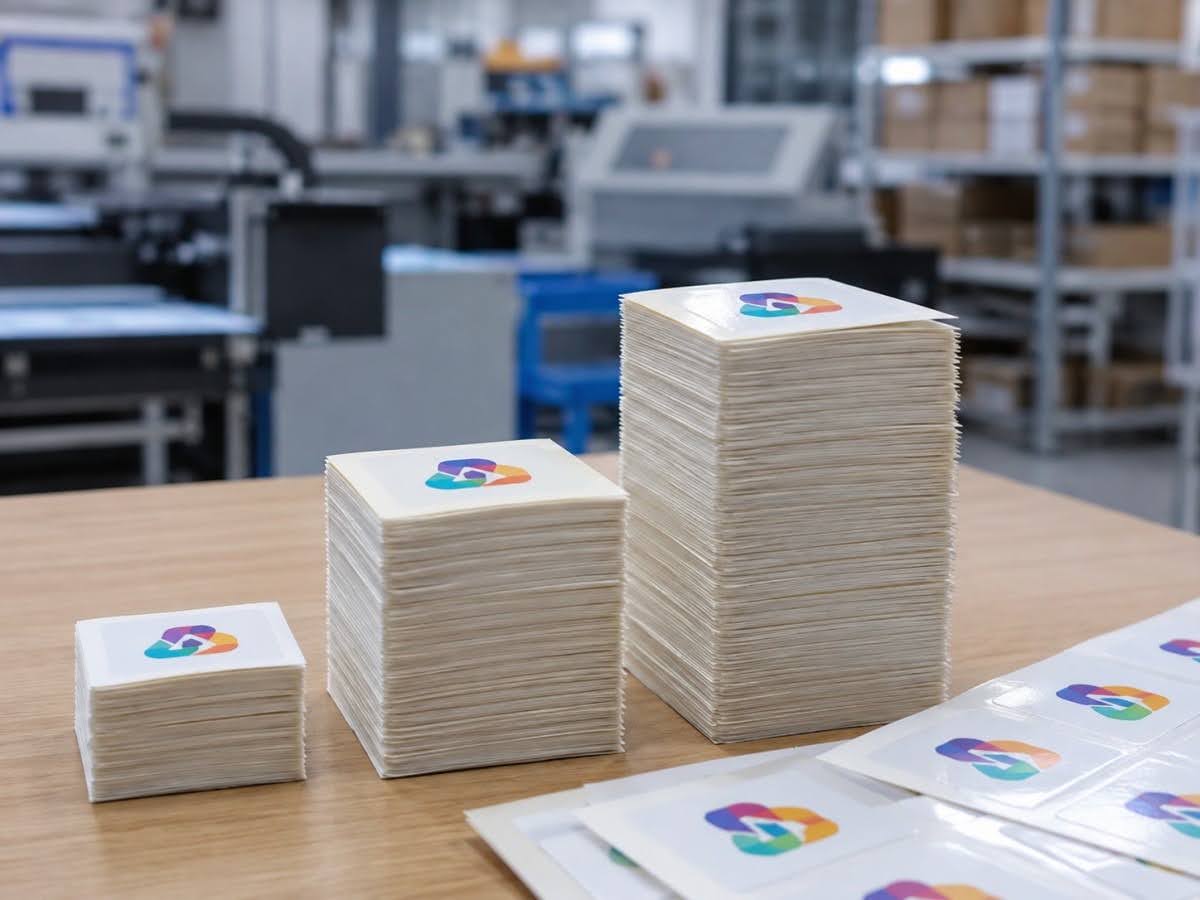
Printing quantity can have a major effect on sticker printing cost per piece.
Why Larger Quantities Often Cost Less Per Sticker
Commercial printing involves fixed setup activities.
These can include:
- Artwork checking
- Machine preparation
- Material setup
- Colour setup
- Cutting setup
- Finishing preparation
Whether a business prints 100 or 10,000 stickers, some of these activities still need to happen.
As the printing quantity increases, fixed setup costs can be distributed across more units.
This is why larger quantities can often achieve a lower unit cost.
Understanding MOQ
MOQ stands for minimum order quantity.
A printing company may establish an MOQ because producing extremely small quantities can be inefficient once setup, material and finishing requirements are considered.
MOQ may vary according to:
- Sticker material
- Printing method
- Size
- Finishing
- Cutting method
Businesses should confirm the applicable MOQ when requesting a quotation.
Bigger Orders Are Not Automatically Better
Lower unit pricing should not encourage businesses to order more labels than they can realistically use.
This is particularly important when stickers contain information that may change, such as:
- Pricing
- Promotional messages
- Product details
- Contact information
- Packaging designs
Printing 20,000 labels may produce a lower cost per unit than printing 5,000, but the savings disappear if half the labels become obsolete.
Consider Annual Usage
Businesses with predictable demand can estimate their sticker usage across a reasonable period.
This can help balance:
- Unit cost
- Storage
- Cash flow
- Risk of artwork changes
- Inventory requirements
The most economical quantity is therefore not always the largest available quantity.
Printing Methods
Different printing technologies have different cost structures and production advantages.
The appropriate method depends on the job specifications rather than price alone.
Digital Printing
Digital printing transfers artwork directly from digital files without requiring conventional printing plates.
It can be suitable for:
- Shorter quantities
- Multiple designs
- Full-colour stickers
- Variable artwork
- Fast production requirements
Because setup can be relatively flexible, digital printing may be economical for smaller or medium-sized custom sticker printing jobs.
Offset Printing
Offset printing involves a different production setup and can provide efficient results for suitable larger-volume work.
The economics depend on:
- Quantity
- Material
- Colour requirements
- Size
- Finishing
The greater setup involved can make it less attractive for certain very small orders but efficient for suitable high-volume production.
Flexographic Printing
Flexographic printing is commonly associated with roll-fed label production and can be useful for larger label volumes.
Applications may include:
- Product labels
- Packaging labels
- Food labels
- High-volume commercial labelling
The initial setup can differ from digital printing, but high-volume production can make the method economical in suitable situations.
Printing Method Should Follow the Job
Businesses do not necessarily need to select the printing technology themselves.
Instead, they should provide accurate specifications such as:
- Quantity
- Size
- Material
- Colours
- Number of designs
- Finishing
- Required delivery date
The printer can then determine an appropriate production method.
Finishing
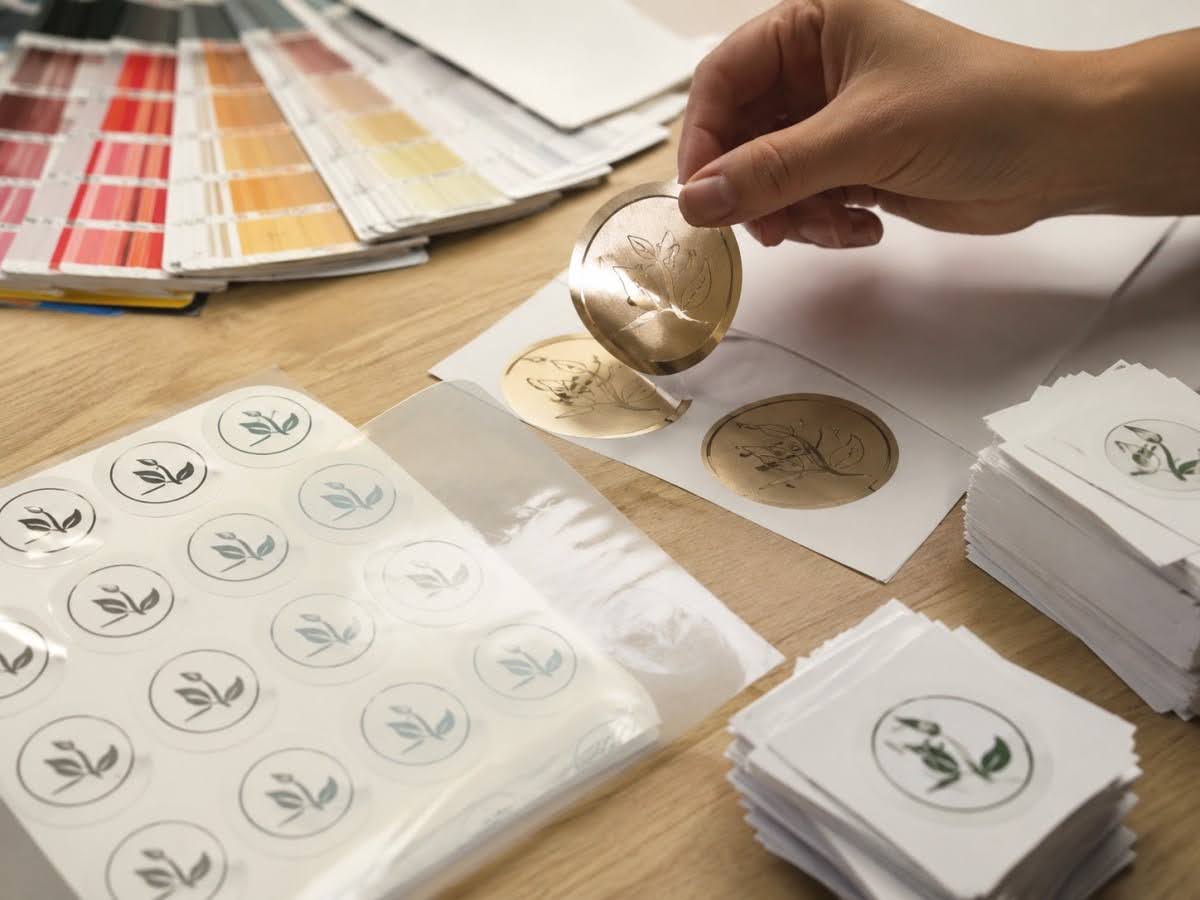
Finishing can improve appearance, durability or both, but each additional process can influence the final printing cost.
Lamination
Lamination applies a protective film over the printed surface.
Common options include:
- Gloss lamination
- Matte lamination
Laminated stickers may provide additional resistance to:
- Moisture
- Scratching
- Frequent handling
- Surface wear
For labels exposed to demanding conditions, this additional protection may justify the cost.
For temporary indoor labels, it may be unnecessary.
Die Cutting
Die cutting creates custom sticker shapes.
Instead of using a standard rectangle or circle, businesses can create stickers that follow:
- Logos
- Product shapes
- Illustrations
- Custom outlines
The cost impact depends on the cutting process, complexity, quantity and production setup.
Specialty Finishing
Additional finishing options can include:
- Foil
- Embossing
- Spot UV
- Specialty coatings
- Custom effects
These can strengthen premium packaging presentation but add production processes.
Businesses should therefore ask whether the finish contributes meaningfully to the product.
A luxury cosmetic label may benefit from foil branding. A temporary logistics label probably will not.
More Finishing Does Not Mean Better Printing
Adding every available finishing option can make a sticker more expensive without making it more effective.
Finishing should solve a specific requirement:
Gloss – polished appearance and potentially additional surface protection.
Matte – reduced reflection and a softer visual effect.
Lamination – increased surface protection.
Foil – metallic visual emphasis.
Die cutting – distinctive custom shape.
Selecting only the processes that provide genuine value can help control costs.
Delivery
Delivery is sometimes overlooked when businesses calculate printing costs.
However, logistics can affect the total project budget.
Standard vs Urgent Delivery
A planned order generally provides greater production flexibility than an urgent one.
Rush requirements may affect:
- Production scheduling
- Material availability
- Finishing
- Courier arrangements
Businesses should therefore avoid leaving recurring label orders until inventory is almost exhausted.
Delivery Location
Delivery cost can vary depending on:
- Location
- Package dimensions
- Weight
- Number of cartons
- Delivery speed
For businesses in Singapore, these factors should be included when comparing quotations from different printing companies.
Packaging Requirements
Certain stickers may require specific packaging to prevent:
- Bending
- Surface damage
- Moisture exposure
- Mixing of product variants
Large orders containing multiple label designs may also need to be packed and identified separately.
Businesses should specify these requirements before production.
Lead Time Is Part of Cost Management
Planning orders early can reduce the need for urgent production or delivery.
A simple stock monitoring system can help businesses determine when to reorder before labels become critically low.
This is particularly valuable for packaging operations where running out of labels can delay the entire fulfilment process.
Ways to Save Costs
Reducing sticker printing costs does not have to mean sacrificing quality.
The best savings usually come from eliminating unnecessary complexity and planning orders efficiently.
1. Choose Materials Based on Real Requirements
Do not automatically select the most durable material.
A waterproof synthetic sticker may be unnecessary for a dry indoor box.
At the same time, do not select paper for a wet environment simply because it is cheaper.
Matching material to application prevents both overspending and premature label failure.
2. Order an Efficient Quantity
Compare pricing across several realistic quantities.
For example:
- 500
- 1,000
- 2,500
- 5,000
The price difference can help identify where unit costs improve significantly.
However, factor in how quickly the labels will actually be used.
3. Standardise Sticker Sizes
Businesses with several products may be able to standardise certain label dimensions.
This can simplify:
- Artwork
- Packaging
- Inventory
- Production planning
Standardisation is particularly useful where multiple product variants share similar containers.
4. Simplify Unnecessary Shapes
Die-cut stickers can strengthen branding, but an extremely complicated shape may not provide enough visual benefit to justify additional complexity.
A cleaner outline can often be more recognisable and easier to produce.
5. Prepare Print-Ready Artwork
Correct artwork can reduce revisions.
Before submission, check:
- Dimensions
- Resolution
- Colour mode
- Bleed
- Safe areas
- Fonts
- Cut paths
Maintaining original vector artwork for logos can also prevent the need for redrawing.
6. Avoid Unnecessary Finishing
Ask what each finish contributes.
If the sticker will be used temporarily indoors, premium lamination may not be necessary.
If a label needs to survive repeated moisture and handling, protective finishing may be worth the additional cost.
7. Consolidate Orders Where Practical
Businesses using several label types may benefit from coordinating orders rather than placing frequent small requests.
Whether this reduces cost depends on the specifications, but consolidated planning can improve operational efficiency.
8. Avoid Last-Minute Printing
Urgent orders reduce flexibility.
Monitor label inventory and reorder early enough to allow normal production and delivery.
9. Provide Complete Specifications When Requesting a Quote
Incomplete information makes accurate pricing difficult.
A useful quotation request should include:
| Requirement | Information to Provide |
| Quantity | Number of stickers required |
| Size | Width × height |
| Material | Paper, vinyl, PET or required performance |
| Shape | Standard or custom |
| Artwork | Number of designs |
| Finishing | Matte, gloss, laminate, etc. |
| Application | Packaging, bottle, equipment, etc. |
| Environment | Indoor, outdoor, wet, refrigerated |
| Delivery | Location and deadline |
If the exact material is unknown, describing the application is often more useful than guessing.
Frequently Asked Questions (FAQs)
How much does sticker printing cost in Singapore?
There is no single standard price because sticker printing cost depends on quantity, size, material, printing method, cutting, finishing, artwork and delivery. Businesses should request a quotation based on their actual specifications.
What affects sticker printing prices the most?
Material, quantity, sticker dimensions and finishing are major factors. Printing method, number of designs, cutting requirements and delivery can also influence the final quotation.
Does ordering more stickers reduce the price?
Larger quantities can often reduce the cost per sticker because setup expenses are distributed across more units. However, the total order cost increases, so businesses should avoid ordering quantities they are unlikely to use.
What does MOQ mean in sticker printing?
MOQ means minimum order quantity. It refers to the minimum number of stickers or minimum production value required for a particular printing process or specification.
Are paper stickers cheaper than vinyl stickers?
Paper can generally be more economical for basic indoor applications, while vinyl provides greater moisture and tear resistance. Actual pricing depends on the complete job specification.
Does lamination increase sticker printing cost?
Yes, lamination adds another production process and material. However, it can provide useful protection against scratching, moisture and repeated handling where those characteristics are required.
Does die cutting cost more?
Custom cutting can affect pricing depending on the shape, production process, setup and quantity. A simple custom outline may also have different production requirements from a highly intricate design.
Is digital printing cheaper for stickers?
Digital printing can be cost-effective for smaller or variable jobs because it avoids certain conventional setup processes. For higher quantities, another printing method may provide better economics depending on the specification.
Does sticker size affect pricing?
Yes. Size influences material consumption and production layout. However, price does not always change proportionally with dimensions because setup and finishing costs also contribute to the total.
Can I reduce printing cost by supplying my own artwork?
Supplying correctly prepared print-ready artwork can reduce the need for artwork preparation and revisions. Files should follow the printer’s requirements for dimensions, resolution, colour, bleed and cutting.
Is the cheapest sticker material always the best way to save money?
No. If a low-cost material fails in the actual environment, replacement and product presentation problems can outweigh the initial saving. The most economical material is one that meets the required performance without unnecessary over-specification.
How can businesses get a more accurate sticker printing quotation?
Provide the printer with quantity, dimensions, material or intended application, number of designs, cutting requirements, finishing, expected environment and delivery requirements. The more complete the specification, the more meaningful the quotation can be.
Get the Right Sticker Specification Before Comparing Prices
A meaningful sticker quotation starts with clear requirements. Comparing price alone can be misleading when materials, durability, cutting, and finishing differ between specifications.
For businesses evaluating sticker printing costs for custom stickers, product labels or packaging labels, Printsys Pte Ltd can help assess the required quantity, material, printing method and finishing options based on the intended application. Get in touch with Printsys today!